100% FREE CONSULTANCY

Moving to the UAE for work or further studies? If your plans involve employment visas, professional licensing, or university admissions, you will almost certainly need certificates attestation in Dubai for your diplomas and degrees. This comprehensive guide explains what attestation is, why it matters, and exactly how to prepare your educational documents so they are accepted by Dubai employers, regulators, and institutions the first time. For a broader context on personal and corporate papers, see our pillar guide: Complete overview: “Documents Attestation Services: The Complete Guide for Personal and Corporate Papers.”
As a Dubai based translation firm, Q Links Legal Translation Services supports you with certified Arabic translations and document preparation guidance, including arranged pickups and door step delivery across Sheikh Zayed Rd, Trade Center, DIFC, Business Bay, Al Barsha, and JLT. Whether you hold a diploma, bachelor’s, master’s, or PhD, this reference will help you navigate requirements with confidence.
Why Educational Attestation Matters in Dubai
In the UAE, attestation verifies that your educational credentials are genuine and issued by a recognized institution. It typically involves authentication by designated authorities in your home country and the UAE. Without proper certificate attestation in Dubai, you may encounter roadblocks such as:
- Delays or denials in work visa processing (e.g., for roles requiring proof of qualification)
- Professional licensing challenges (e.g., healthcare, education, engineering, legal, finance)
- University admissions or credit transfer complications
- Employment onboarding delays for employers in DIFC, Business Bay, and along Sheikh Zayed Rd
Attested educational documents are often required by HR departments, free zone authorities, and government entities. In Dubai, attestation from the UAE Ministry of Foreign Affairs (MOFAIC) and, when applicable, certified Arabic translations are frequently requested.
What Counts as an Educational Certificate?
Educational certificates include any credential that evidences formal education or training. These commonly include:
- Diplomas (high school, vocational, technical, or post secondary)
- Degree certificates (bachelor’s, master’s, PhD)
- Transcripts/mark sheets, provisional certificates, and course completion letters
Employers and authorities in Dubai often ask for both the certificates atestation in Dubai and supporting documents like transcripts or mark sheets. For regulated professions, you may also need an academic equivalency from the UAE Ministry of Education (MoE) in addition to attestation (note: equivalency is a separate process from attestation).
The Attestation Journey: Home Country to the UAE
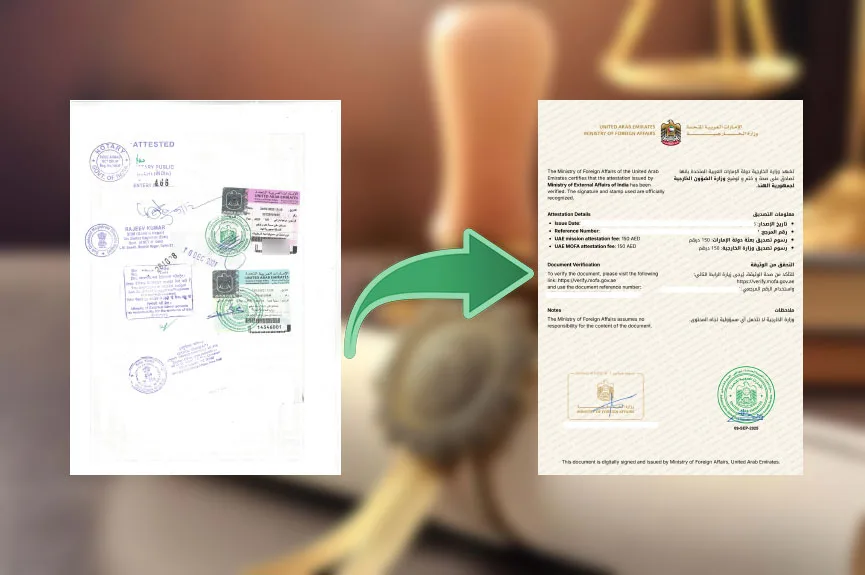
Although steps vary by issuing country, most attestation pathways for educational documents involve the following sequence:
- Verification by the issuing body or educational authority (e.g., university, board, or ministry)
- Notarization or verification by a recognized notary/public official (when required)
- Attestation by the home country’s relevant education authority (e.g., higher education commission/board)
- Attestation by the home country’s Ministry of Foreign Affairs (or equivalent)
- Attestation by the UAE Embassy/Consulate in the home country
- Final attestation by MOFAIC in the UAE
- Certified Arabic legal translation (when requested by the receiving authority)
Source:
[1] Documents attestation. (n.d.). mofa.gov.ae. Retrieved December 24, 2025, from https://www.mofa.gov.ae/en/services/attestation
Diploma Certificates Attestation in Dubai: Step-by-Step
Diplomas (including vocational and technical credentials) are common requirements for skilled trades and entry level professional roles across Dubai’s hubs such as JLT, Al Barsha, and Trade Center. A typical process includes:
1) Institution Verification
Ensure your diploma is verifiable by the issuing institution or governing board. Obtain transcripts or mark sheets if available some authorities require these to validate the diploma’s authenticity.
2) Notarization/Local Verification
In many countries, diplomas must be notarized or verified by a designated education board or notary public before they can be sent for higher level authentication.
3) Education Authority Attestation
Submit your diploma to the relevant education authority (for example, state/provincial board or national education council) to confirm it was issued by an accredited institution.
4) Home Country’s Foreign Affairs Attestation
The Ministry of Foreign Affairs (or equivalent) in your home country will authenticate the signature/stamp of the education authority.
5) UAE Embassy/Consulate Attestation
Your diploma must then be attested by the UAE Embassy/Consulate in the issuing country to be recognized in the UAE.
6) MOFAIC Attestation in the UAE
After arrival in Dubai, obtain the final attestation from MOFAIC. This renders the document officially valid for use in Dubai.
7) Certified Arabic Legal Translation
If requested by your employer, free-zone authority, or another government body, arrange an Arabic legal translation. Q Links Legal Translation Services provides certified Arabic translations with convenient scheduling near Sheikh Zayed Rd and Business Bay.
Degree Certificates Attestation in Dubai: Step-by-Step (Bachelor’s, Master’s, PhD)
Degree attestation follows a similar sequence but may require additional checks, especially for regulated occupations in healthcare, engineering, law, or education. Here is the typical pathway:
- University Verification: Confirm the degree is issued by an accredited university. Some universities issue verification letters or sealed transcripts.
- Notarization (If Applicable): Depending on your country, a notary or university registrar’s certification may be needed.
- Higher Education Authority Attestation: This could be a national commission, ministry, or accreditation body. Ensure all pages that carry signatures/stamps are authenticated.
- Home Country Foreign Affairs: The ministry verifies the authenticity of the previous authority’s signature/stamp.
- UAE Embassy/Consulate: Obtain attestation from the UAE mission in the issuing country.
- MOFAIC (UAE): Complete the final attestation after arriving in the UAE.
- Arabic Legal Translation (If Required): Provide certified Arabic translations when requested. Q Links can help translate your degree, transcripts, and related documents, with door-step delivery in DIFC, JLT, and Al Barsha.
Note: Academic equivalency from the UAE Ministry of Education is distinct from certificates attestation in Dubai. Some employers or licensing bodies (e.g., DHA/DoH for medical professionals) may require both. Check your role’s specific requirements.
Diploma vs. Degree: Key Differences at a Glance
| Aspect | Diploma | Degree (Bachelor/Master/PhD) |
|---|---|---|
| Use Cases | Skilled trades, vocational roles, some admin roles | Professional/managerial roles, regulated professions |
| Typical Verification | Institution/board + home MOFA + UAE Embassy + MOFAIC | University + higher education authority + home MOFA + UAE Embassy + MOFAIC |
| Frequent Extras | Transcripts/mark sheets | Transcripts + possible UAE MoE equivalency (role-dependent) |
| Translation | Arabic legal translation if requested | Arabic legal translation if requested |
Country Specific Notes (Illustrative)
While the overall framework is similar, each issuing country has its own authorities and sequence. Always verify with official sources and your university:
- India: Often involves university verification, state HRD/SDM (if applicable), Ministry of External Affairs (MEA), UAE Embassy, and MOFAIC. For degrees, UGC recognition of the university is important.
- Pakistan: Typically includes HEC verification for degrees, Ministry of Foreign Affairs, UAE Embassy, and MOFAIC.
- United Kingdom: May involve verification via a solicitor/notary and the Foreign, Commonwealth & Development Office (FCDO), then UAE Embassy and MOFAIC.
- United States: Processes often include notarization and Secretary of State authentication, U.S. Department of State, UAE Embassy, and MOFAIC.
- Philippines: CHED/DepEd, DFA authentication (Apostille or equivalent per current policy), UAE Embassy (as required), then MOFAIC.
- Egypt: Verification from the issuing university, Ministry of Higher Education, Ministry of Foreign Affairs, UAE Embassy, and MOFAIC.
Required Documents Checklist

Before you begin certificates attestation in Dubai, prepare a complete file to avoid delays:
- Original diploma or degree certificate
- Transcripts/mark sheets (sealed if your authority requires)
- Photocopies of certificate and transcripts
- Passport copy (and UAE visa page if available)
- Offer letter or admission letter (if requested by the receiving authority)
- Authorization letter (if someone is submitting your documents on your behalf)
- Completed application forms for each authority (as applicable)
- Fee payment receipts
Timelines, Fees, and Practical Tips
Processing time for certificates attestation in Dubai depends on your issuing country, the responsiveness of your institution, and the current workload of authorities.
- Timelines: Home country steps can take from a few days to several weeks. MOFAIC attestation in the UAE is often completed within a few working days, provided all earlier steps are in order.
- Fees: Each stage (notary, education authority, foreign ministry, UAE Embassy, MOFAIC, translations) may charge separate fees.
- Translations: If your receiving authority requires Arabic, arrange certified Arabic legal translation after MOFAIC attestation unless your employer requests it earlier.
- Accuracy: Ensure names, dates, and grades align across all documents. Even small discrepancies can cause rejections.
- Planning: Start early, especially if you’re accepting a job in DIFC or Business Bay where onboarding timelines are tight.
Arabic Legal Translation: When and Why It’s Needed
Many Dubai-based entities accept English language educational documents. However, certain government departments, courts, and licensing authorities may require Arabic versions. Certified Arabic legal translations ensure your attested diploma or degree is accurately represented in Arabic and is accepted for official use.
Q Links Legal Translation Services provides:
- Certified legal translations of diplomas, degrees, and transcripts
- Fast turnaround and quality assurance for technical academic terminology
- Convenient online submissions and door-step delivery to Sheikh Zayed Rd, Trade Center, DIFC, Business Bay, Al Barsha, and JLT
Local Support Across Dubai’s Key Districts
Whether you’re joining a firm near Sheikh Zayed Rd, starting a role in the Trade Center area, onboarding to a financial institution in DIFC, or relocating to JLT or Al Barsha, Q Links Legal Translation Services streamlines the language component of your attestation journey. Our team helps you:
- Review document sets and identify what needs translation versus attestation
- Coordinate certified Arabic translations post-MOFAIC attestation
- Manage logistics with online and door-step delivery options to save time during onboarding
Common Mistakes That Delay Attestation (and How to Avoid Them)
- Missing transcripts: Some authorities will not authenticate certificates attestation in Dubai without transcripts. Request them from your institution early.
- Name mismatches: Differences between your passport and certificate can trigger verification delays. Provide supporting affidavits if necessary.
- Skipping an authority step: Going directly to MOFAIC without home-country authentications usually results in rejection.
- Using uncertified translations: For legal use, ensure translations are from certified legal translators recognized in Dubai.
- Outdated information: Fee schedules and required steps can change. Always double-check the latest requirements with MOFAIC and your home authorities.
Source:
Services. (n.d.). mofa.gov.ae. Retrieved December 24, 2025, from https://www.mofa.gov.ae/Services
Frequently Asked Questions
Yes, attestation and language are separate. Even English-language degrees typically require attestation for official use in Dubai. Translation into Arabic is only requested by certain entities; verify what your employer or licensing body needs.
Attestation confirms authenticity of your documents. Equivalency (from the UAE Ministry of Education) evaluates how your qualification compares to UAE standards. Some roles require both.
No. MOFAIC typically requires proof that your certificate was authenticated by your home-country authorities and the UAE Embassy/Consulate in that country.
Expect a few days for MOFAIC attestation once prerequisites are complete. Overall timelines vary by country and institution; plan for several weeks if you’re starting from scratch.
Q Links Legal Translation Services specializes in legal, certified, and general translation and can guide you on document preparation and sequencing for attestation. For end-to-end logistics, we can coordinate with attestation partners and support you with Arabic translations and convenient delivery options across Dubai.
Conclusion: Start Your Certificates Attestation in Dubai the Right Way
Whether you’re validating a diploma for a technical role in JLT or attesting a master’s for a position in DIFC, a clear plan saves time. Use this guide to map your steps home country verification, UAE Embassy authentication, MOFAIC finalization, and certified Arabic translation where required.
For expert assistance with document review and translation, Q Links Legal Translation Services offers online and door step support throughout Sheikh Zayed Rd, Trade Center, Business Bay, Al Barsha, and beyond. For a broader context covering personal and corporate papers, see our main guide: Complete overview: “Documents Attestation Services: The Complete Guide for Personal and Corporate Papers” If you need a quick checklist or a translation quote, contact Q Links today and move forward with confidence in your certificates attestation in Dubai.