100% FREE CONSULTANCY
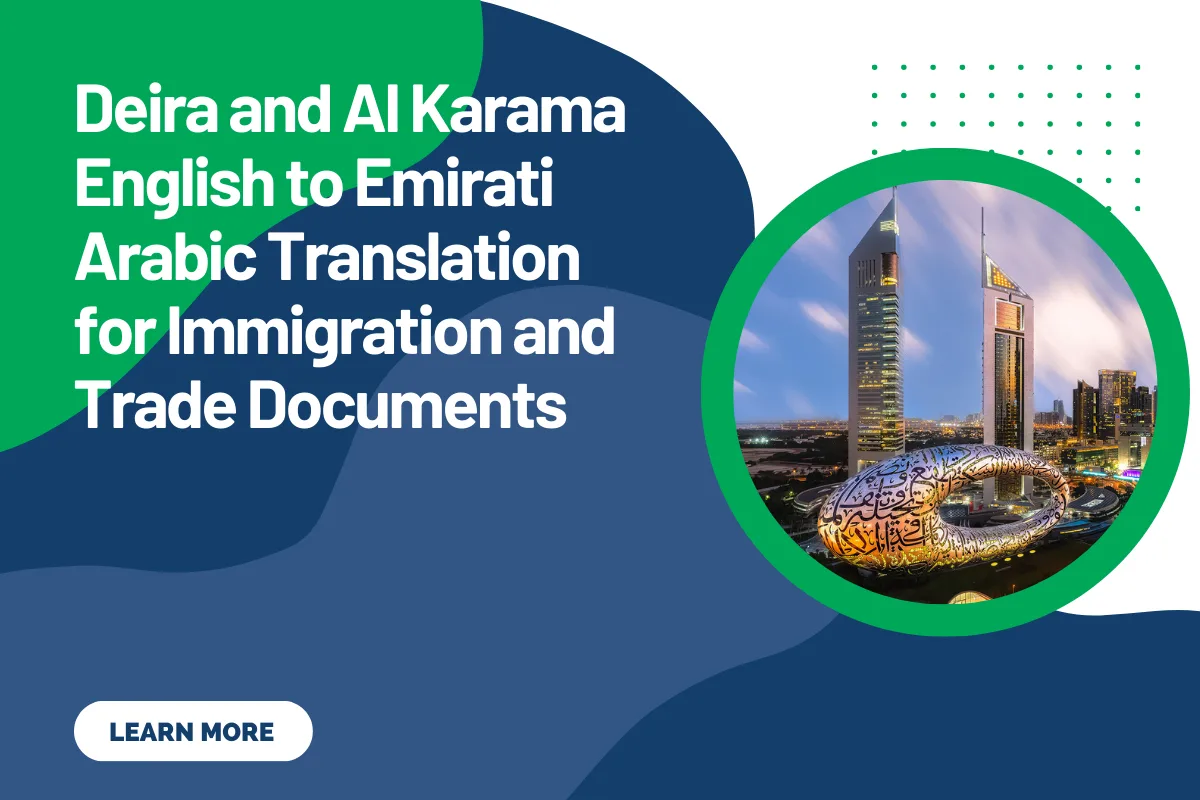
Dubai’s busiest neighborhoods depend on clear communication. In Deira’s trading lanes and Al Karama’s residential and retail blocks, people and companies handle visas, permits, contracts, and invoices every day. When these texts cross languages, English-to-Emirati Arabic translation keeps meaning correct and context intact. With stakes tied to residency decisions and cross-border shipments, errors can delay progress or create avoidable risk.
This cluster article explains how translation supports Immigration and Visa Services and Corporate and Commercial trade workflows in these areas. It describes document types, dialect choices, compliance steps, and quality checks, plus a practical framework to manage multilingual files end to end. Drawing on local realities, it shows how to plan for clarity from drafting to submission. As you explore, note how certified work and accurate terminology benefit both individual cases and business operations.
For readers seeking professional context in the UAE market, Q Links Legal Translation Services is referenced as an experienced Dubai-based provider. While this guide is informational rather than promotional, it highlights the checks and terminology decisions that experienced teams apply to keep official texts accurate, consistent, and submission-ready.
Table of Contents
Quick Summary
In Deira and Al Karama, immigration files and trade paperwork often move between English and Emirati Arabic. Success relies on understanding dialect-specific terms, the legal register, and how authorities interpret intent. This article highlights common document types, risks to watch for, and a practical workflow to validate identity details, dates, units, and clauses across languages.
For Immigration and Visa Services, the focus is on personal status records, certificates, and supporting letters. For Corporate and Commercial processes, the emphasis falls on invoices, contracts, and compliance documents. The guide includes a human-versus-machine translation comparison, a step-by-step quality framework, and localized tips for Deira and Al Karama submissions. It also addresses bilingual needs in both directions, including Emirati Arabic to English for international correspondence.
Why Translation Matters for Immigration and Trade in Dubai
Immigration submissions and customs-linked trade documents must reflect precise meanings. A small error in a birth date or shipment description can lead to requests for clarification or resubmission. Using a legal register and domain-specific terms helps authorities interpret content correctly and match it to supporting records and systems.
For a deeper foundation before applying this neighborhood-focused guidance, see The Complete Guide to English to Emirati Arabic Translation for Personal, Business, and Legal Use in Dubai, which explains broader definitions, use cases, and standards relevant across the emirate.
Effective multilingual communication preserves intent, avoids ambiguity, and supports compliance checks. Whether the audience is a visa officer or a customs reviewer, translated documents should foreground clarity and consistency. One practical tactic is to align translations with accompanying forms, templates, and reference IDs so that information flows predictably through each submission stage.
Understanding Emirati Arabic: Dialect Nuances in Official Documents
Emirati Arabic differs from Modern Standard Arabic in vocabulary, expressions, and tone. Legal and official texts still rely on a formal register, yet knowledge of local usage improves the rendering of names, places, and institutional references. Translators must choose terms that fit the legal purpose while preserving the writer’s intent and audience expectations.
Personal names, tribal or family elements, and transliterations require careful handling to match passports and previous filings. Numbers, currencies, dates, and measurement units must be formatted with consistency. When dealing with explanatory letters, translators balance a respectful tone with direct, concise wording appropriate for official review. This blend of accuracy and restraint underpins dialect-sensitive terminology choices throughout the document set.
According to the UAE Ministry of Foreign Affairs, document attestation helps ensure that official records are recognized when used across borders (UAE Ministry of Foreign Affairs, n.d.). Attestation of Official Documents, Certificates and Commercial Invoices
Immigration and Visa Documents: What Needs Precise Rendering
For the Immigration and Visa Services journey, typical source texts include passports and ID pages, birth or marriage certificates, academic transcripts, police clearances, and supporting letters. Affidavits, sponsorship letters, and explanations of purpose also appear in applications. Each item should match prior records precisely, including name order and spellings.
Where legal meaning controls outcomes, Emirati Arabic legal translation uses terms accepted in official contexts while keeping personal facts unchanged. Attachments and references should align with application forms and any scheduling communications. In bilingual cases, notes can go in both directions. For international updates or letters to non-Arabic institutions, Emirati Arabic to English is used.
Practical checks include verifying that date formats are consistent throughout the file set, cross-referencing document numbers, and confirming that jurisdiction names are correctly translated. When multiple documents share a theme, a consolidated glossary ensures that the same term appears the same way across the entire submission.
Corporate and Commercial Trade Documents: Accuracy at Scale
In the Corporate and Commercial space, traders and companies manage purchase orders, commercial invoices, packing lists, certificates of origin, and contracts. Board resolutions, powers of attorney, and tender responses also move between English and Emirati Arabic. Clarity supports customs review, banking operations, and partner onboarding.
Contractual wording benefits from stable term mapping, especially for obligations, warranties, and limitation clauses. Product descriptions should be specific and repeatable, matching catalog or HS code references. The goal is trade documentation clarity that supports predictable processing, reduced back-and-forth, and easier reconciliation with financial systems.
When operational teams maintain bilingual glossaries and templates, translators can keep form fields, standard clauses, and numeric formats uniform. This uniformity helps when volumes increase or new markets are added, lowering the time needed to review, validate, and archive translated files.
Deira and Al Karama: Local Context for Submissions and Workflows
Deira’s traditional markets and trading houses often handle fast-moving purchase cycles, while Al Karama blends residential, retail, and small business activities. In both neighborhoods, people rely on typing centers, courier services, and digital portals to move documents. Submission points and procedures vary, so planning for the right format and copies is essential.
When preparing immigration files in Deira, applicants often compile personal status documents alongside letters and forms that reference case numbers. In Al Karama, tenants and shop owners may update permits, contracts, or attested records connected to renewals. Coordinating translations with these realities supports local submission practices where timing, completeness, and clarity are critical.
For cross-neighborhood workflows, keep a checklist that aligns translation delivery with booking dates, courier pickups, or portal upload windows. Small steps like naming files consistently or including cover pages with bilingual summaries can reduce administrative back-and-forth and help reviewers follow the thread of a case or a shipment.
Quality and Compliance Framework: A Practical Step-by-Step Approach
Consistent outcomes depend on a reliable quality assurance workflow. The following framework helps teams and individuals keep translations accurate, traceable, and ready for submission without last-minute edits.
- Scoping and intake: Define the target audience, jurisdiction, and purpose. Identify whether the register must be legal, technical, or generally official. Collect reference files and prior approvals.
- Terminology setup: Compile a bilingual glossary for names, institutions, and recurring terms. Include number, currency, and date conventions to avoid mixed formats.
- Primary translation: Render the text with attention to context, document type, and evidentiary function. Track any ambiguous phrases for later clarification.
- First review: Check completeness, consistency, and alignment with references. Confirm that attachments, annexes, and cross-references match the source.
- Legal and compliance alignment: Ensure the legal register fits the document’s purpose. For immigration or trade, verify that required statements are present and unambiguous.
- Proofreading and formatting: Standardize typography, transliteration of names, and page layout. Ensure signatures, stamps, and seals are positioned correctly.
- Final validation: Reconcile numbers, dates, and IDs across the file set. Prepare any required bilingual summaries or cover notes to guide reviewers.
- Submission readiness: Package files for upload or physical delivery with clear naming and an index. Keep a record of the final version and glossary for future updates.
If you want to understand how this framework relates to broader translation standards in the city, see the complete guide on this topic, and then adapt those principles to the specific requirements you face in Deira or Al Karama.
Human vs Machine: Why Domain Expertise Matters
Generic machine tools often default to Modern Standard Arabic, which can miss dialect nuances or legal phrasing. In contrast, a skilled professional applies context, register, and institutional knowledge. The difference shows up in names, obligations, and cultural references, where context-aware human review preserves meaning and avoids ambiguity.
| Aspect | Human Emirati Arabic translator | Generic Arabic machine output |
|---|---|---|
| Register and tone | Matches legal or official style for immigration and trade | Inconsistent; may default to general or informal text |
| Dialect handling | Understands Emirati usage and local references | Leans toward MSA; misses Emirati nuances |
| Names and transliteration | Aligns with passports and prior filings | Unreliable; variations across documents |
| Legal meaning | Preserves obligations and rights precisely | Can blur or invert legal intent |
| Quality control | Review, proofreading, and reconciliation steps | No structured review unless added manually |
| Submission readiness | Formatted to match authority expectations | Often needs extra editing to meet standards |
Working With Professionals: Process, Turnaround, and Confidentiality
Effective collaboration starts with a clear brief, reference files, and timelines aligned to submission windows. Ask about review stages, terminology management, and how updates are handled if source files change. For time-sensitive cases, agree on milestones for drafts, internal checks, and final delivery to avoid last-hour revisions.
When you need certified outputs for official use, clarify formatting, page order, and any requirements for bilingual summaries or cover notes. For an overview of service scope in Dubai and how professionals implement these steps, consider English to Emirati Arabic translation to understand how translation projects are structured from intake to delivery.
Data protection and secure file transfer protect sensitive personal and commercial information. Ask how teams implement access control, encryption, and archiving policies. Clear protocols support confidential handling for everything from immigration records to trade contracts, reducing the risk of version drift and unauthorized edits.
FAQs
- What is the difference between Emirati Arabic and Modern Standard Arabic in official texts?
Modern Standard Arabic is widely used for formal writing, but Emirati Arabic influences names, institutions, and local terms. Legal translations balance formal register with context so documents read correctly for UAE authorities.
- Which immigration documents most often require translation in Deira and Al Karama?
Common items include birth and marriage certificates, academic transcripts, police clearances, and supporting letters. Files must match previous records in spelling, numbers, and dates to avoid clarification requests.
- How should companies manage product descriptions and units across bilingual trade files?
Use a shared glossary and templates for product names, HS codes, and units of measure. Consistency across invoices, packing lists, and certificates improves customs review and internal reconciliation.
- Do I need a specific legal register for contracts moving between English and Arabic?
Contracts benefit from a formal legal register with established terms for obligations and remedies. A domain-aware translator ensures clauses retain the intended meaning in both languages.
- How can I minimize rework before an immigration or trade submission?
Confirm names, dates, and document numbers first, then align translation formats with portal or courier requirements. A checklist and final reconciliation pass reduce last-minute changes.
- When is Emirati Arabic to English needed in these neighborhoods?
It is useful for international correspondence, supplier onboarding, or when authorities or partners outside the UAE request English copies of locally issued records.
- What file formats work best for bilingual document sets?
PDF for final submissions and editable formats for drafts allow controlled review and clear versioning. Keep naming conventions stable and include an index when sending multiple files.
- How do interpreters fit into immigration or commercial processes?
Interpretation supports interviews, meetings, and calls tied to applications or contracts. Coordinating interpreters with known agendas and glossaries improves accuracy during live discussions.
Conclusion
In Deira and Al Karama, trusted communication underpins both immigration progress and trade continuity. With careful planning, English to Emirati Arabic translation preserves legal meaning, supports authority expectations, and keeps files aligned from intake to submission. Dialect-aware choices, reliable terminology, and structured reviews help individuals and companies avoid costly delays and clarifications.
This guide outlined document types, local context, and a practical quality framework, along with a comparison showing why human expertise matters. Whether you are preparing a visa application or finalizing shipping paperwork, clarity across languages is a strategic advantage. Contact Q Links Legal Translation Services for expert assistance, and adapt the practices here to your specific timeline and documentation set so each submission proceeds smoothly.