100% FREE CONSULTANCY
Cross-border transactions, multi-jurisdictional disputes, and regulatory reviews demand more than literal word swaps. They require the precision and judgment of an Emirati Arabic translator who understands legal nuance, corporate context, and how language impacts risk. At the intersection of law and business, words can shape outcomes and reputations, as well as enforceability across languages and legal systems.
Q Links Legal Translation Services supports this mission with certified legal translation, professional interpretation, and multilingual solutions trusted across the UAE. Our teams handle sensitive legal, corporate, and financial documentation with confidentiality and quality controls aligned to UAE requirements. For global counsel and corporate stakeholders, we help synchronize language with intent so that every clause, figure, and definition moves cleanly between English and Emirati Arabic.
This cluster article focuses on how legal and corporate teams can operationalize quality when working with an Emirati Arabic translator. It explores competencies, workflows, quality assurance models, and the unique realities of serving sophisticated matters. The goal is to help legal services, financial services and banking, and corporate and commercial stakeholders build reliable, defensible translation processes that align with professional standards.
Table of Contents
Quick Summary
This guide explains the capabilities and workflows that underpin reliable Emirati Arabic translation for legal and corporate use. It covers how to scope work, choose between English-to-Emirati Arabic translation and Emirati Arabic-to-English, and implement coherent terminology and formatting controls. It also outlines confidentiality safeguards, review models, and when to involve interpretation for hearings or negotiations.
Practical takeaways include aligning purpose and audience, implementing glossaries and style guidance, and establishing reviewer roles that match matter risk. The discussion emphasizes how an Emirati Arabic legal translator manages context, authority references, and document structures so translated deliverables remain usable, compliant, and ready for legal scrutiny.
What an Emirati Arabic Translator Delivers for Legal and Corporate Work
A seasoned legal translator delivers more than accurate sentences. They provide legal-grade accuracy aligned with contract architecture, regulatory language, and the documentary practices of legal and corporate teams. Precision involves reconciling meaning across jurisdictions, interpreting defined terms consistently, and mirroring numbering, cross-references, and schedules without introducing ambiguity.
For orientation across personal, business, and legal contexts, see The Complete Guide to English to Emirati Arabic Translation for Personal, Business, and Legal Use in Dubai. It provides a broad overview of requirements and considerations that complement the legal and corporate focus outlined in this article.
A capable team treats the translation as a functional deliverable, not just a linguistic product. That means respecting filing standards, preserving exhibits and annexes, and ensuring that page flow, signatures, stamps, and dates are captured consistently where required. This approach supports review cycles, client approvals, and downstream use, whether in advisory, transactional, or dispute settings.
Specialized Competencies of an Emirati Arabic Legal Translator
Matters that touch contracts, policies, court submissions, or regulatory materials rely on an Emirati Arabic legal translator with targeted expertise. Core capabilities include domain-specific terminology control, sensitivity to legal drafting conventions, and awareness of how defined terms propagate through lengthy documents. These competencies maintain coherence across sections and related exhibits.
Competence also involves the ability to parse complex syntactic structures common to legal English and render them accurately in Arabic without overcomplication. For English to Emirati Arabic translation, this can require restructuring to maintain readability without diluting legal effect. For Emirati Arabic to English, concise legal English that tracks intent and scope is equally critical.
Professional judgment is essential when encountering ambiguous or legacy phrasing. Translators flag unclear provisions, suggest clarifications if invited, and annotate where context may be required. This disciplined editorial mindset keeps counsel informed and preserves a clear audit trail of translation decisions.
Choosing Between English to Emirati Arabic Translation and Emirati Arabic to English
Legal teams often alternate between English to Emirati Arabic translation and Emirati Arabic to English. Selecting direction depends on the audience and the governing language of the matter. A high-performing team offers bidirectional capability with consistent terminology so that parallel versions remain aligned across drafts and approvals.
Consider how purpose influences choices. If a contract will be negotiated primarily in English but referenced locally, translating key clauses may suffice. Where filing or official use is expected, full translation and formalities can be scoped. The table below highlights directional considerations that commonly shape project plans.
| Aspect | English to Emirati Arabic | Emirati Arabic to English |
|---|---|---|
| Primary audience | Local stakeholders who read Arabic | Global counsel and counterparties |
| Drafting style | Preserve legal effect with clear Arabic syntax | Render concise, standard legal English |
| Terminology | Map English legal terms to accepted Arabic usage | Translate Arabic legal terms to established English equivalents |
| Formatting | Maintain exhibits, schedules, and cross-references | Mirror numbering and defined terms accurately |
| Review focus | Clarity for Arabic readers and local process needs | Clarity for international counsel and negotiations |
Regardless of direction, the translation process should anticipate revisions and parallel redlines. Version control and clear file naming conventions help teams track changes and keep both language versions synchronized throughout drafting cycles.
Terminology, Formatting, and Confidentiality Controls for Legal Teams
Legal and corporate matters rely on predictable, repeatable controls. Start with a bilingual glossary and a short style guide so that translators apply consistent terms across contracts, policies, and notices. This is the core of terminology management and reduces rework during reviews by counsel and stakeholders.
Formatting practices should align with how documents are used. Keep section numbering identical, preserve footnotes and headings, and label annexes consistently. Maintain pagination logic so cross-references and summaries function as expected, especially when documents will be compared side by side.
Confidentiality is operational as well as contractual. Limit access to named linguists and reviewers, and share files through secure channels according to client instruction. A clear intake protocol with confidentiality notes, file-handling guidance, and destruction or retention instructions supports disciplined document hygiene.
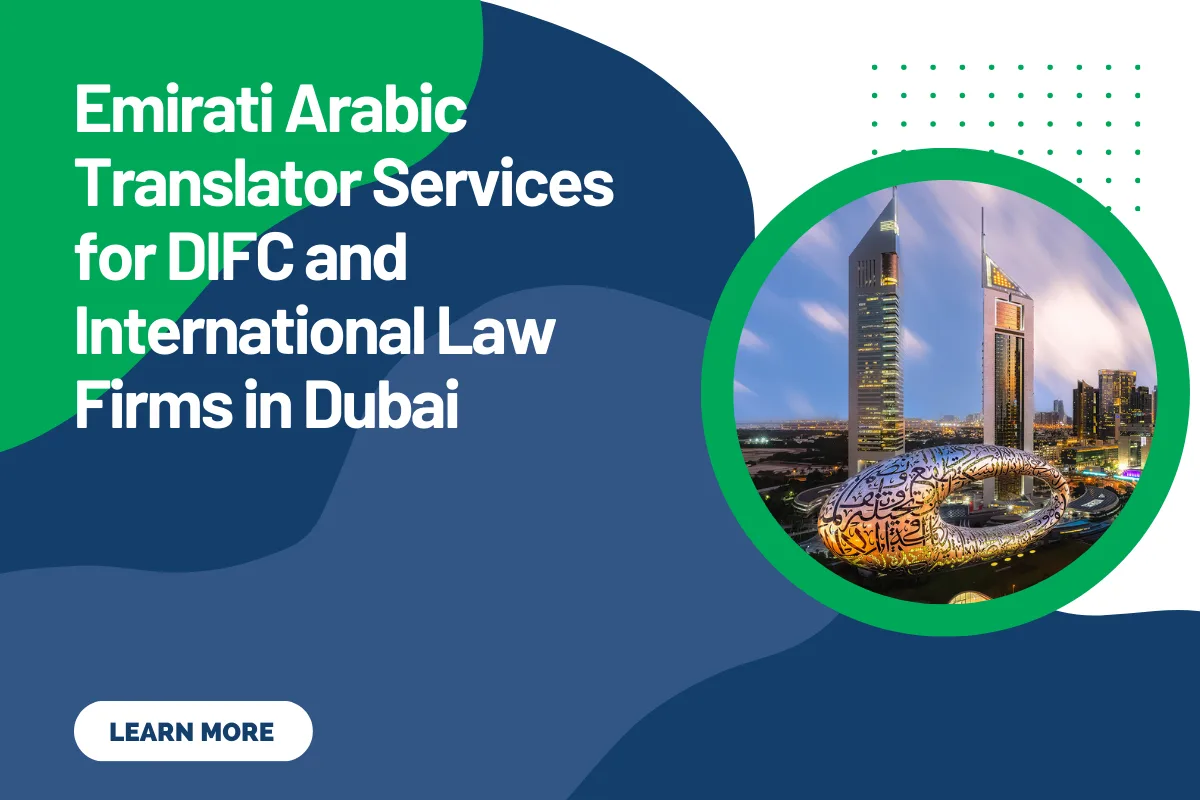
DIFC Realities: Serving International Law Firms and Financial Institutions
Teams working with matters connected to the DIFC often face complex cross-border documentation and tight alignment between legal services and corporate and commercial stakeholders. International counsel and in-house legal teams may require localized versions for regional use while preserving the authority of the governing language for filings or negotiations in other jurisdictions.
In this context, accurate Emirati Arabic legal translation supports clarity for decision-makers, regulatory reviews, and internal policy adoption. For Financial Services and Banking, consistency across product terms, KYC materials, and risk disclosures promotes operational reliability. For Corporate and Commercial teams, harmonized board materials and transaction documents help maintain momentum through approval gates.
Translation partners should be comfortable with regulated-document workflows, secure file exchange, and predictable delivery aligned to client processes. When on-site or remote interpretation is required for meetings or proceedings, the same partner can help coordinate schedules, briefing materials, and terminology lists to ensure smooth interactions among international participants in Dubai and the DIFC.
Practical Framework: Secure Translation Workflow for Firms
The right workflow reduces risk and accelerates reviews. The following framework is designed to fit legal services, financial services and banking, and corporate and commercial teams that manage sensitive, versioned documents and multi-stakeholder approvals.
1) Scoping and purpose alignment
Define audience, governing language, and intended use. Identify whether full translation or excerpts are required and mark any clauses that require special attention. Early clarity supports a targeted plan and enables a two-pass review where needed for critical content.
2) Intake and security
Use a secure channel and instruct how files should be handled, stored, and returned. Provide prior versions, term sheets, or glossaries. Flag sensitive sections and any preferred wording that must be preserved across iterations.
3) Glossary and style confirmation
Confirm key terms and drafting tone before translation begins. Keep the glossary lightweight and editable so it can adapt as counsel revises definitions or scope during negotiations or internal reviews.
4) Translation production
Assign appropriate linguists based on subject matter and document type. Maintain file structure, labels, and internal cross-references. Track questions for counsel rather than guessing when the text is ambiguous or heavily contextual.
5) Bilingual review and QA
Use a dedicated reviewer to confirm terminology, clarity, and coherence. Annotate where necessary, resolve translator notes, and prepare a clean deliverable with change history captured if required by the client.
6) Delivery with version control
Return files following naming conventions and security instructions. Supply a change log or reviewer notes when appropriate to help legal teams conclude approvals quickly and confidently.
For additional background on motivations, use cases, and audience targeting across personal and corporate contexts, see our in-depth guide to English to Emirati Arabic translation. It complements this workflow by explaining how purpose and audience shape scope and direction.
Quality Assurance, Review Models, and Measurable Outcomes
Quality is the product of structure and discipline. A robust model includes translator self-checks, independent reviewer passes, terminology validation, and final formatting verification. This creates bilingual quality assurance that can withstand scrutiny by counsel, auditors, and stakeholders relying on the translated text.
For larger programs, consider assigning document families to the same team so familiarity snowballs over time. Keep a living glossary, note handling instructions for recurring structures, and preserve client preferences. This institutional memory improves accuracy and reduces cycle time on future matters.
Define what success means before work starts. Typical outcomes include clean cross-referencing, stable terminology across versions, and reader readiness for the intended audience. These anchors help everyone judge completeness and confirm that the translation is usable in real workflows.
When to Engage Interpreters vs Translators in High-stakes Matters
Documents and live conversations serve different needs. Translators produce precise artifacts for review and filing, while interpreters enable real-time understanding in meetings, negotiations, and court-related settings. Selecting the right service avoids friction and supports outcomes.
For live scenarios, choose consecutive or simultaneous interpretation depending on event format and attendee mix. Provide preparatory materials so interpreters can align with subject matter and preferred terminology. For document-heavy matters, pair translation with a briefing session so counsel can validate how key terms and definitions are being handled.
When the same partner supports both translation and interpretation, shared glossaries and context allow smoother handoffs. Teams gain speed when everyone references the same terms and document structures across written and spoken channels.
Frequently Asked Questions
Look for demonstrated experience with legal documents and a reliable review process. Evidence of specialized capability often shows in consistent terminology, structured delivery, and thoughtful handling of defined terms and cross-references.
Align scope with the document’s purpose and audience. If only certain clauses are negotiated or referenced, excerpts may suffice. For official or broader internal use, full translation with formatting controls is typically preferred.
Yes. Transactions and policies change as counsel refines terms. Treat your glossary as a living resource that updates with each draft so both the English and Arabic versions remain synchronized throughout negotiations or approvals.
Share files through secure channels, restrict access to named linguists and reviewers, and provide explicit instructions for storage and deletion. Ask your translation partner to confirm handling protocols and points of contact.
Use interpretation for live discussions, including negotiations, briefings, or proceedings. Use translation for records, contracts, and filings. For complex matters, combine both services and align terminology across channels.
Establish a version control system, a bilingual glossary, and reviewer roles. Keep track of redlines in both language files and reconcile changes during each iteration to prevent divergence between English and Arabic texts.
Conclusion
High-stakes legal and corporate matters benefit from a structured partnership with an experienced Emirati Arabic translator. By aligning purpose, audience, and workflow, teams gain reliable outputs that stand up to review and serve real operational needs. Clarity improves, rework declines, and decision-makers can rely on translations that match the intent and function of the original.
Q Links Legal Translation Services supports these outcomes with certified legal translation, interpretation, and multilingual solutions tailored to complex environments. Our approach prioritizes confidentiality, terminology discipline, and quality assurance so that documents and discussions remain accurate and usable across teams.
Whether you need English to Emirati Arabic translation for contracts and policies or Emirati Arabic to English for counsel and counterparties, we can help design a workflow that scales with your matter. Contact Q Links Legal Translation Services for expert assistance.