100% FREE CONSULTANCY
Accurate English-to-Emirati Arabic translation is essential for life and work in the UAE. Whether you are submitting a court document, finalizing a commercial contract, preparing immigration paperwork, onboarding employees, or sharing a medical report, the choice of translator and the approach to dialect and terminology will shape outcomes.
This guide explains what makes Emirati Arabic unique, when certified translation is required, how to prepare documents, and how to avoid common pitfalls that delay approvals or weaken agreements. Built for individuals and organizations operating in regulated contexts, it also clarifies key differences between Modern Standard Arabic and regional dialects and offers a practical framework for choosing the right service every time.
Throughout, you will find guidance grounded in the realities of legal, corporate, academic, medical, and public sector communication in the UAE, plus location insights for clients across Dubai. If you need a compliant and reliable service partner, Q Links Legal Translation Services provides Emirati Arabic translations that align with UAE expectations.
Table of Contents
Quick Summary
This guide shows how to plan and execute English to Emirati Arabic translation across legal, immigration, medical, academic, commercial, and government use cases. You will learn how dialects work in practice, what certified translation means in the UAE context, how to prepare your files, and how to reduce risk through clear scoping and quality checks. It also explains when to choose Emirati Arabic vs. Modern Standard Arabic and how to collaborate with translators for accurate terminology, names, and dates. A comparison table, a decision framework, and FAQs help you move from questions to action with confidence. Contact Q Links Legal Translation Services for expert assistance.
Why Accurate Translation Matters in Dubai
In Dubai’s multilingual environment, translation is never just word substitution. The accuracy of a translation affects how an authority, investor, supplier, customer, school, or hospital interprets your intent. In legal and regulated contexts, the translation can directly influence eligibility, compliance, and timelines. A well-planned workflow ensures that terminology, dates, figures, names, and instructions are rendered in a way that is both linguistically correct and operationally useful for the receiving party. For personal documents, these benefits can mean faster approvals. For businesses, it can mean fewer contract ambiguities. For public sector interaction, it can mean smooth coordination and recordkeeping. With the right Emirati Arabic translator, you protect meaning, tone, and legal force across languages.
Understanding the Emirati Arabic Dialect
Emirati Arabic is part of the Gulf Arabic family and is used widely in daily speech across the UAE. It differs from Modern Standard Arabic, which is used in formal writing, media, education, and official documents. Emirati Arabic has its vocabulary preferences, pronunciation patterns, and expressions that provide local communication warmth and authenticity. When people ask questions such as, “Is Emirati Arabic different?” or “Emirati Arabic vs. Saudi Arabic,” the answer is that each variety reflects its region’s history and usage. Within the UAE, you will hear differences from place to place and across generations and settings. For customer engagement, internal memos, and brand storytelling intended for a local audience, choosing to translate to Emirati Arabic can make content sound naturally local, provided it is done by a native professional who understands register and audience needs.
Clients also ask about everyday expressions, such as “yes” in Emirati Arabic, “how are you” in Emirati Arabic, how to say “how are you” in Emirati Arabic, “see you tomorrow” in Emirati Arabic, i miss you” in Emirati Arabic, and “yalla” in Emirati Arabic. These are common queries, and the exact wording can shift by context, formality, and speaker preference. For accurate phrasing in a specific scenario, consult a native professional.
Legal Translation Fundamentals in the UAE
Legal translation focuses on preserving meaning, structure, and enforceability across languages. In practice, this means aligning the source text with target language conventions while safeguarding defined terms, party names, clause numbering, and references.
In the UAE, legal translation is used for a wide range of documents, such as court submissions, powers of attorney, contracts, corporate resolutions, and official certificates. Precision matters because a small change in phrasing can alter obligations or rights. A strong review process ensures that dates, numbers, and stamps are legible and consistent and that formatting supports quick reference. For cross-border agreements, the translator should consider how the target audience will interpret terms and how to avoid ambiguity without rewriting the contract.
Q Links Legal Translation Services provides Emirati Arabic translations designed for legal and official use. Our teams prioritize clarity, confidentiality, and the consistency required by regulated workflows. For expert assistance, contact Q Links Legal Translation Services.
English to Emirati Arabic Translation What Makes Legal Documents Different in the UAE
Certified vs General Translation: What You Need and When
General translation is suitable for materials that do not require official acceptance by an authority. Marketing campaigns, internal newsletters, or informal communications often fall into this category. Certified translation is intended for use in official or legal contexts where authorities, courts, universities, or licensed entities request formally accepted translations. The certification process and acceptance criteria vary by purpose and recipient, so clarifying requirements in advance protects your timeline.
How to scope your request
- Define the purpose: court filing, visa submission, academic use, or internal reference.
- Identify the recipient’s acceptance rules.
- Flag any stamps, seals, handwritten notes, and annexes.
- Confirm spellings for names and places as they appear on passports or IDs.
- Provide editable files when available for higher fidelity and fewer retypes.
Q Links Legal Translation Services supports both general and certified workflows, aligning with UAE expectations for legal, immigration, academic, medical, and commercial translation. For expert assistance, contact Q Links Legal Translation Services.
How to Choose an Emirati Arabic Legal Translator for Courts and Contracts in Dubai
Immigration and Visa Translation Essentials
Immigration and visa applications typically involve identity documents, family certificates, employment letters, and financial records. The translation must be complete, readable, and consistent with source details. Even minor discrepancies between a translation and the original spelling can cause complications. Align name spellings with travel documents and verify whether the receiving authority requests any notarization, legalization, or specific formatting to reduce rework.
For time-sensitive submissions, plan buffer time for quality checks. If your case includes letters or statements, plain and direct language helps the translator preserve meaning and tone. For official acceptance contexts across the UAE, Q Links Legal Translation Services provides Emirati Arabic translations. For expert assistance, contact Legal Translation Services.
Emirati Arabic Translation for Immigration and Visa Services Avoiding Costly Application Delays
Medical and Healthcare Translation Essentials
Healthcare translation involves medical histories, diagnostic reports, prescriptions, and discharge summaries. Accuracy safeguards patient care and coordination among providers. When translating between Emirati Arabic and English, terminology must be rendered in standard medical language to ensure clarity for practitioners while remaining faithful to the original. Consistent use of units, dosage instructions, and procedure names is critical. Legibility of scans and attached lab results helps avoid gaps. If a document contains abbreviations, consider adding a glossary or expansion list to reduce ambiguity. Where clarity is uncertain, request a translator query log before finalization.
Q Links Legal Translation Services supports sensitive medical content with privacy-focused workflows and experienced translators who handle specialized terminology. For expert assistance, contact Q Links Legal Translation Services.
Emirati Arabic to English Translation for Medical Reports and Hospital Records in Dubai
Academic and University Translation Essentials
Academic processes often require translating diplomas, transcripts, course descriptions, recommendation letters, and personal statements. Universities may request specific formatting or notarized copies. Providing clear scans, legible stamps, and a list of proper names helps maintain consistency. If you need both Emirati Arabic to English or English to Emirati Arabic, define the language direction for each document. Consistency across multiple files is as important as accuracy within a single file.
Q Links Legal Translation Services delivers an English-to-Emirati Arabic Translation Service tailored to university admissions and credential evaluation workflows in the UAE. Contact Q Links Legal Translation Services for expert assistance.
Translate to Emirati Arabic for University Admissions, Diplomas, and Academic Certificates
Corporate and Commercial Translation Essentials
Companies operating in the UAE translate shareholder agreements, board resolutions, commercial licenses, HR policies, vendor contracts, and marketing collateral. For legal and procurement documents, the translator must respect defined terms and cross-references, particularly in bilingual contracts that may specify a controlling language. Choosing Emirati Arabic for customer-facing content can enhance its resonance with local audiences, provided you select the tone and register carefully. Aligning with brand voice requires a brief that explains target personas and usage channels.
When working with technical or engineering materials, supplement the brief with product glossaries or standards references.
Ramos, F. P. (2014). Quality assurance in Legal translation: evaluating process, competence, and product in the pursuit of adequacy. International Journal for the Semiotics of Law – Revue Internationale De Sémiotique Juridique, 28(1), 11–30. https://doi.org/10.1007/s11196-014-9390-9
Q Links Legal Translation Services supports corporate teams with organized handoffs, version control, and consistent terminology across departments and deliverables. Contact Q Links Legal Translation Services for their expert assistance.
Corporate Contracts: Why English to Emirati Arabic Translation Matters for Commercial Deals
Government and Public Sector Communication
Government and public sector communication requires clarity, neutrality, and careful formatting. Translation may cover regulations, public notices, forms, reports, and memoranda. The translator should avoid colloquialisms unless the context calls for public engagement content where a local voice is required. Many authorities have style preferences. Accurate numbers, dates, and references are essential for internal circulation and public release.
Q Links Legal Translation Services aligns work with the expectations of UAE-based bodies and public entities for consistent, official communication. Contact Q Links Legal Translation Services for expert assistance.
Government and Public Sector Compliance: Using an Emirati Arabic Legal Translator in the UAE
Real Estate and Property Transactions
Property sales, leases, handover documents, and homeowners association materials require consistent translation of party names, plot identifiers, unit numbers, and payment schedules. Lease clauses, renewal terms, and handover obligations need special attention because a subtle shift in modality or time reference can change meaning. For marketing brochures or tenant guides aimed at residents, Emirati Arabic can make content friendlier to local audiences. For legal contracts, confirm whether the receiving party requires Modern Standard Arabic, Emirati Arabic, or a bilingual layout.
Q Links Legal Translation Services helps real estate stakeholders translate agreements and resident materials with clarity and consistency. Contact Q Links Legal Translation Services for their expert assistance.
Real Estate Contracts: English to Emirati Arabic Translation for Property Sales and Leases
Financial Services and Banking Documents
Banking and financial services translation includes account agreements, KYC documents, credit terms, insurance policies, and investment disclosures. Financial terminology must be consistent with accepted usage to avoid confusion for customers and regulators. Tables, schedules, and annexes should preserve structure, and numeric formatting should follow recipient conventions. For bilingual agreements, confirm which version prevails in case of discrepancy. To expedite review cycles, share product glossaries at kickoff if you keep them up to date.
Q Links Legal Translation Services supports financial institutions and corporate finance teams with careful handling of sensitive materials and consistent terminology. Contact Q Links Legal Translation Services for expert assistance.
Financial Services and Banking: When You Need Emirati Arabic Legal Translation of Agreements
Where We Serve in Dubai: Location Guide
Clients across Dubai choose to work with a provider who understands how and where documents are used. The following notes describe common expectations that local clients raise during scoping. Each location has its blend of corporate offices, public services, and community needs. If your case relates to a specific office or authority, share that detail early so the translation team can align formatting and terminology with practical use.
Sheikh Zayed Road
Enterprises along this corridor often request fast, high-quality turnarounds for board materials, commercial filings, and bilingual contracts. Many also seek localization to Emirati Arabic for brand consistency in the UAE market.
English to Emirati Arabic Translation Services on Sheikh Zayed Road: What Local Clients Expect
Trade Center
Trade Center clients frequently need document sets that move between free zones, ministry interfaces, and private stakeholders. Clarity and consistent formatting reduce back-and-forth between parties.
Emirati Arabic Legal Translation Near Trade Center: Serving Courts, Free Zones, and Offices
DIFC
International law firms and financial institutions value precise terminology management, especially when agreements reference foreign law with local execution.
Emirati Arabic Translator Services for DIFC and International Law Firms in Dubai
Business Bay
Growing companies often balance brand storytelling with contract compliance. Scoping a mixed set of tasks across marketing, HR, and legal helps teams coordinate schedules and approvals.
Business Bay Companies: When to Translate to Emirati Arabic for Commercial Contracts
Deira and Al Karama
Residents and small businesses frequently request immigration support, trade documents, and everyday official paperwork. Clear copies and aligned name spellings speed up acceptance.
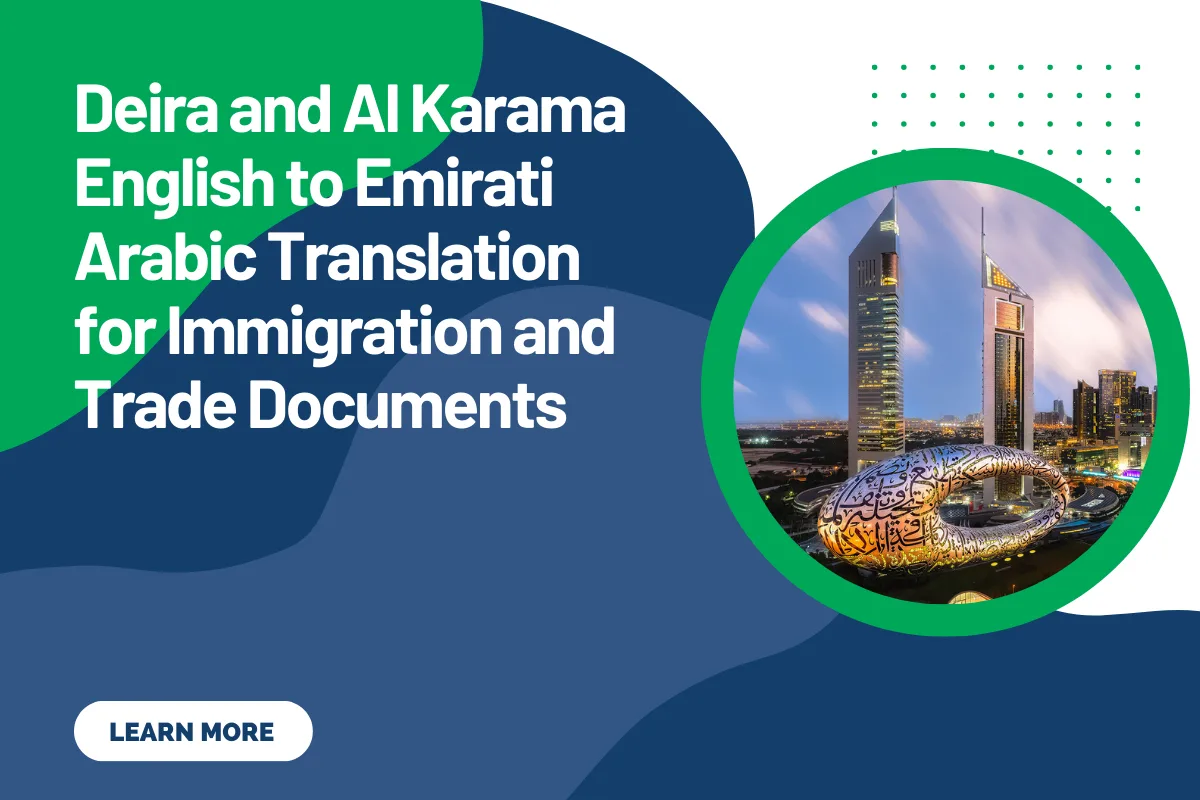
Deira and Al Karama: English to Emirati Arabic Translation for Immigration and Trade Documents
Al Karama
Many individuals seek Emirati Arabic to English translations for residency, licensing, and commercial registration tasks. Straightforward scoping reduces processing time.
Legal Translation in Al Karama: Emirati Arabic to English for Residents and Small Businesses
Al Barsha and Barsha Heights
Residents often require certified sets for education, employment, and tenancy. Sharing submission requirements with the translator helps align deliverables with recipient needs.
Certified Emirati Arabic Translation for Residents of Al Barsha and Barsha Heights
JLT, Dubai Marina, and Jumeirah
Corporate clients and entrepreneurs here commonly request bilingual business contracts, vendor agreements, and customer policies with clear, enforceable language.
Emirati Arabic Translator for JLT, Dubai Marina, and Jumeirah Business Contracts
Budgeting and Timelines for Legal Translation
Costs and schedules depend on document length, complexity, formatting needs, certification steps, and urgency. To receive an estimate, provide page counts, samples, and any special requirements like notarization or legalization. Batch related documents together to improve consistency and reduce repeated review time. Ask for a delivery plan that includes draft review, query resolution, and finalization.
Q Links Legal Translation Services offers structured handoffs and progress updates to align expectations with delivery. For expert assistance, contact Q Links Legal Translation Services.
How Much Does an Emirati Arabic Legal Translator Cost for Court Cases in Dubai?
Comparison: Emirati Arabic vs Other Arabic Varieties
Choosing between Emirati Arabic and Modern Standard Arabic depends on purpose and audience. For official filings and most legal documents, recipients typically expect Modern Standard Arabic or bilingual formats. For brand voice, customer care, and community messaging, Emirati Arabic can create a more natural local experience. When audiences span multiple regions, consider Modern Standard Arabic or a neutral Gulf voice to maintain broad accessibility. If you are comparing Emirati Arabic vs. Saudi Arabic for a cross-border initiative, align on audience geography and stakeholder expectations before translation begins.
| Aspect | Emirati Arabic | Modern Standard Arabic | Saudi Arabic |
|---|---|---|---|
| Primary use | Everyday speech, localized content | Official documents, media, education | Everyday speech in Saudi regions |
| Register | Colloquial to semi-formal | Formal and standardized | Colloquial to semi-formal |
| Official filings | Typically not used for formal filings | Commonly used for formal filings | Typically not used for formal filings |
| Audience reach | Best for UAE-local audiences | Broad across Arabic-speaking regions | Best for Saudi-local audiences |
| Terminology | Localized vocabulary and expressions | Standardized terminology | Localized vocabulary and expressions |
| Brand voice | Warm, local tone when used appropriately | Neutral, formal tone | Warm, local tone for Saudi audiences |
| Risk if misapplied | Perceived informality in official contexts | Perceived stiffness in casual content | Perceived regional mismatch for UAE |
| Script and layout | Arabic script, right-to-left | Arabic script, right-to-left | Arabic script, right-to-left |
Decision-Making Framework: How to Proceed
- Define purpose and audience
- Official filing, court use, or regulatory submission
- Customer engagement, brand storytelling, or internal training
- Choose language variety
- Modern Standard Arabic for official and legal contexts unless instructed otherwise
- Emirati Arabic for UAE-localized, audience-friendly content
- Assemble your materials
- Provide editable files when possible
- Supply any prior translations, glossaries, and style notes
- Clarify acceptance requirements
- Ask the recipient what they require for certification, stamps, or format
- Request a timeline and quality plan
- Include draft review, query resolution, and final checks
- Approve terminology and spellings early
- Confirm names, places, and technical terms before the main translation run
- Finalize and store securely
- Maintain version control and archive originals and translations together
Q Links Legal Translation Services can help you complete each step with a clear briefing, collaborative review, and delivery aligned with UAE practices. Contact Q Links Legal Translation Services for their expert assistance.
Everyday Phrases and Etiquette in Emirati Arabic
When people explore the Emirati Arabic dialect’s characteristics and features, they often want to learn polite greetings and common expressions. Many of these overlap with other Gulf varieties, and usage can vary by age group and setting. If your team plans to write customer scripts or community messages, agree on tone and formality first.
Common queries we receive
- How to say “how are you?” in Emirati Arabic: the phrasing shifts based on formality and audience.
- Yes, in Emirati Arabic, the everyday equivalent can vary by context.
- I miss you in Emirati Arabic: personal expressions should reflect relationships and registers.
- See you tomorrow in Emirati Arabic: conversational sign-offs depend on tone.
- “Yalla” in Emirati Arabic is widely understood as an informal prompt to go or proceed and is used across many Arabic varieties.
For public-facing content, it is wise to test your draft with native speakers before rollout. Modern Standard Arabic is preferred for official documents unless the recipient specifically asks for a dialect. Q Links Legal Translation Services can align scripts and messages with your brand voice for UAE audiences.
FAQs
Use Modern Standard Arabic for legal, academic, and official documents. Use Emirati Arabic for UAE-localized content such as marketing, community engagement, and customer care when a local voice will improve connection.
It depends on the recipient. Verify acceptance criteria with the authority, court, university, or organization before commissioning the work.
Yes. Define the language direction for each file at kickoff and share any preferences for the transliteration of names and places.
Provide clear scans, confirm spellings as per passports or IDs, and check if any additional steps like notarization are required.
Editable files help retain layout and reduce retyping. If you only have scans, ensure they are legible and include all pages, stamps, and annexes.
Yes. A shared glossary aligns terminology across documents and team members and shortens review time.
Include legible scans and flag any sections that are difficult to read. The translator may request clarification to avoid misinterpretation.
Confirm recipient preferences. Where unspecified, translators follow clear and consistent formatting that supports correct interpretation.
Q Links Legal Translation Services operates with confidentiality and secure handling practices to protect sensitive information.
Share target personas, sample messages, and approval rules. If using Emirati Arabic, define formality levels and test representative phrases with native reviewers.
Conclusion
Effective English-to-Emirati Arabic translation is about more than accuracy. It is about context awareness, recipient expectations, and the choices that protect meaning in official and everyday communication.
By clarifying your purpose, scoping the deliverables, and choosing the right language variety, you improve acceptance and reduce rework across legal, immigration, medical, academic, and commercial tasks. When in doubt, verify requirements early and work with specialists who can manage terminology, formatting, and certification steps appropriate to the UAE.
Q Links Legal Translation Services provides Emirati Arabic translation, trusted by individuals, companies, and public sector stakeholders who need reliable, confidential, and high-quality language support. For expert assistance, contact Q Links Legal Translation Services.