100% FREE CONSULTANCY
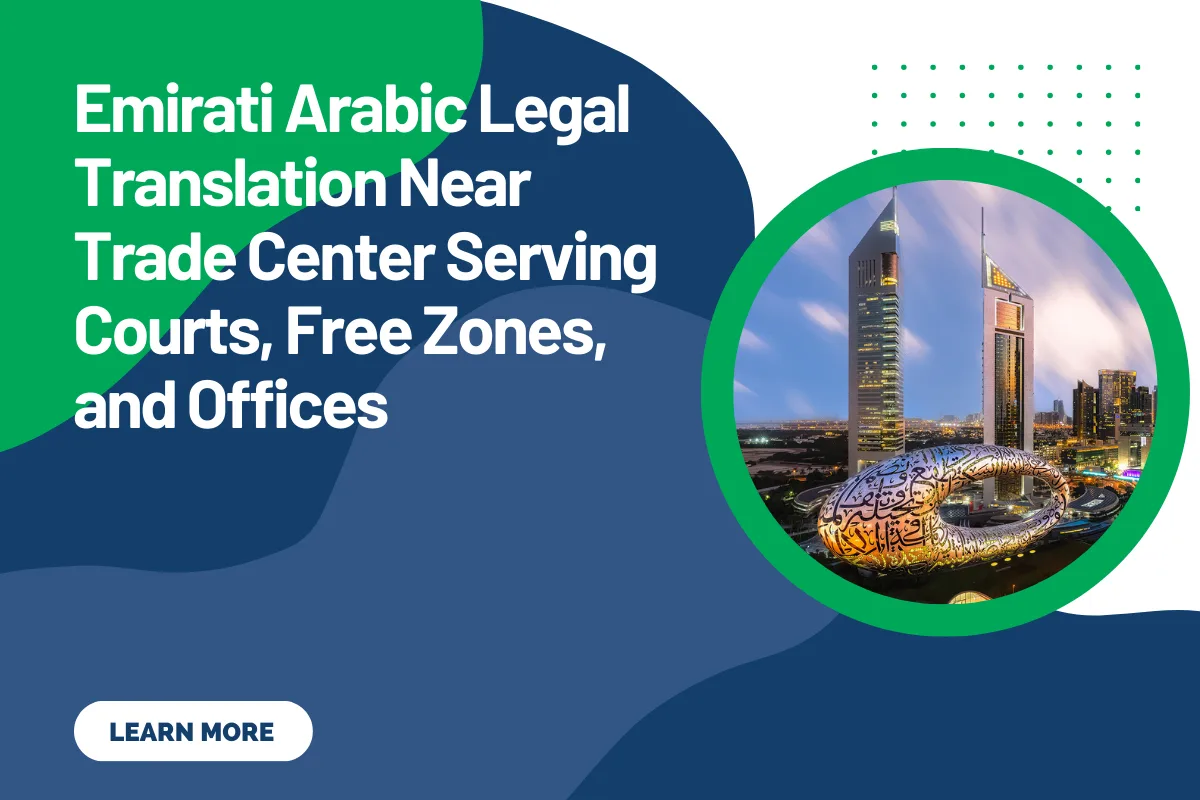
Legal, corporate, and administrative teams in Dubai often handle multilingual documentation with high stakes and tight timelines. When a contract, court bundle, or company resolution needs to move between English and Arabic, context is everything. In Dubai, the variety of Arabic used across official, business, and legal settings requires precision. That is why Emirati Arabic legal translation is more than word-for-word conversion; it is about legal meaning, jurisdictional nuance, and document readiness for official use.
Q Links Legal Translation Services supports this work daily in Dubai, guiding clients on how to plan, prepare, and quality-check translations for courts, free zones, and corporate offices. This article explains how Emirati Arabic functions in legal and commercial contexts, the frameworks that help reduce risk, and the practical steps to collaborate effectively with translators and reviewers. It also highlights how teams near Trade Center can streamline workflows for routine filings and complex projects alike.
Table of Contents
Quick Summary
This cluster guide explains how to plan and execute Emirati Arabic work for legal and commercial documentation in Dubai. It focuses on clarity of source files, terminology control, formatting for submissions, and choosing between human, hybrid, or machine-supported approaches. You will find a step-by-step framework, a comparison table, and practical collaboration tips for corporate and legal teams near Trade Center.
The content aligns with the broader knowledge base on English to Emirati Arabic translation, including document intake, review cycles, and final readiness for official environments. It addresses typical requirements for court materials, free zone filings, and office-ready communications, helping you choose the right methods for your risk profile and timeline.
Why Emirati Arabic Legal Translation Matters for Courts, Free Zones, and Offices
Legal and business documents carry obligations, rights, and time-sensitive instructions. When moving between English and Arabic, the translator must capture intent precisely and respect jurisdictional terminology that readers in Dubai expect. For filings, letters, and submissions, contextual accuracy protects both the message and the outcome.
If you are building your internal knowledge, an early orientation helps. See how English to Arabic workflows operate across personal, business, and legal scenarios in Dubai in The Complete Guide to English to Emirati Arabic Translation for Personal, Business, and Legal Use in Dubai to understand common document types and preparation steps.
Understanding Emirati Arabic in Legal Contexts
Arabic in the UAE includes local usage, regional influences, and Modern Standard Arabic for formal writing. In legal materials, phrasing must be both natural for readers in Dubai and aligned with legal conventions. A seasoned legal register keeps documents authoritative without drifting into colloquial phrasing.
Teams often request English to Emirati Arabic translation for contracts, corporate policies, and submissions, then need Emirati Arabic to English for evidence, exhibits, and correspondence. The goal is consistency across both directions, so a single glossary and style guidance applies whether you need an Emirati Arabic legal translator or a general Emirati Arabic translator for background materials.
For complex matters, collocations and fixed legal phrases require careful handling. Idiomatic translation is avoided where it clouds meaning; literal translation is avoided where it misleads. A balance between fidelity and clarity keeps terms enforceable and readable.
Use Cases Across Legal Services and Corporate & Commercial
Within Legal Services, translation supports litigation bundles, pleadings, evidence summaries, powers of attorney, and correspondence between counsel, clients, and institutions. In these settings, document traceability matters: teams track who translated, who reviewed, and what terminology was approved.
Within Corporate & Commercial, English-to-Emirati Arabic translation is frequent for contracts, shareholder resolutions, HR policies, internal directives, and vendor communications. Emirati Arabic to English appears in regulatory responses, bank letters, and third-party documentation received in Arabic. Coordinated, bilingual templates reduce turnaround and improve alignment among departments.
For cross-functional projects, naming conventions, roles, and dates must be harmonized. A single, agreed style guide helps procurement, legal, and compliance work from the same reference, avoiding fragmented versions.
Location Focus: Near Trade Center in Dubai
Organizations near Trade Center often manage regional headquarters functions with frequent external correspondence and internal communications. When preparing documents for meetings, sign-offs, or official submissions, proximity encourages quick iterations. A simple, structured intake for translation (with clear file names and version control) keeps these timelines on track.
Typical scenarios include end-of-day contract revisions for next-morning signings, bilingual board packs, or summary translations of exhibits for counsel. Teams that centralize requests, define priorities, and identify decision-makers reduce back-and-forth and shorten approval cycles.
If your day includes coordinating with counsel, notaries, or free zone administrators, consider a routing checklist. It should note which items require bilingual headers, which require original-language attachments, and which can proceed with summaries pending full translation.
Quality Framework: From Source to Court-ready Arabic
Effective translation for legal and corporate work follows a repeatable method. The framework below supports consistency and reduces rework when documents move to formal environments.
- Scoping: Define purpose, audience, and deadline. Mark whether the output must be submission-ready or for internal review. Clarify intended legal effect.
- Source preparation: Provide editable files, final text, and references. Flag defined terms and any clauses under negotiation.
- Terminology setup: Compile or update the bilingual glossary. Validate names, titles, and entities across languages.
- Initial translation: Focus on accuracy and structure. Maintain paragraph numbering, headings, and cross-references.
- Bilingual review: A second linguist checks legal register, definitions, and consistency. Resolve edge cases in comments.
- Formatting and checks: Apply layout, pagination, and exhibits. Confirm dates, figures, and annex labels. Perform final QA.
- Client sign-off: Approve or comment on specific clauses. Freeze terminology for future iterations.
- Archiving: Store approved files, glossary updates, and review notes for future matters.
For a structured perspective on planning and workflows, see the complete guide on this topic and adapt its planning tips to your court or corporate context.
Standards can also inform how teams think about process. According to the International Organization for Standardization, translation quality management benefits from defined steps for resources, pre-production, and review cycles (ISO 17100). This helps formalize roles for translators and revisers and establishes traceable quality records (International Organization for Standardization, 2015). ISO 17100:2015 Translation services
Terminology, Formatting, and Evidentiary Readiness
Terminology choices influence enforceability and readability. Maintain a single glossary for defined terms and legal phrases. Flag any industry-specific vocabulary to avoid ambiguity. A translator’s term consistency across documents prevents drift in meaning that could complicate reviews.
Formatting matters for submissions and corporate files alike. Mirror headings, numbering, and exhibit references. Where stamps, signatures, or seals appear in source files, add a translator note that they appear in the source and indicate their placement without altering content.
For evidentiary materials, include source-language snippets where needed to preserve original intent. If content is summarized, mark it clearly as a summary and retain the full translation in your records for later use.
Choosing the Right Path: Human, Hybrid, or Machine
Not all documents require the same approach. Consider risk, audience, and timeline before selecting your method. A policy memo may tolerate light post-editing, while pleadings or contracts typically require human-led accuracy with second-pass review.
| Approach | Best For | Strengths | Risks |
|---|---|---|---|
| Human Translation with Review | Contracts, pleadings, formal letters | Highest accuracy, legal register, nuance | Longer timelines than machine-only |
| Hybrid: Machine + Professional Post-editing | Internal memos, background materials | Faster, cost-efficient for low-risk content | May miss edge-case legal nuances |
| Machine-only | Rough understanding of non-critical text | Immediate speed | High risk of errors in legal contexts |
When in doubt, opt for a conservative approach on documents that could affect rights, obligations, or timelines. Use machine output only where misinterpretation carries minimal risk.
Working With Professionals in Dubai
Professional linguists offer structure, terminology control, and iterative review that in-house teams may not have bandwidth to maintain. A clear scope, defined reviewers, and a shared glossary keep projects predictable and efficient. In many projects, a bilingual reviewer from your team adds valuable business context that a linguist can calibrate to.
For formal matters or complex filings, explore Emirati Arabic legal translation solutions that explain processes, document handling, and review layers. This ensures you understand what will happen between intake and delivery and how your records will be maintained for future use.
When planning the working rhythm, agree on delivery batches, checkpoints, and sign-off milestones. This way, legal and corporate teams can route drafts to decision-makers without delays.
Collaboration Tips for an Emirati Arabic Translator
Effective collaboration reduces rework and strengthens clarity. First, provide final or near-final source files. Then supply references: previous translations, defined terms, and approved phrases. These assets let your translation memory grow so consistency improves over time.
Second, identify an in-house reviewer for names, product terms, and internal abbreviations. Whether you are working with an Emirati Arabic legal translator or a general Emirati Arabic translator, a single point of contact for approvals keeps communication focused.
Third, mark non-translatable segments, such as trademarks, code snippets, or stamps, to avoid accidental changes. Clear instructions at the outset save time later.
Risk Management and Confidentiality
Legal and commercial documents often contain sensitive data. Define access controls early, limit distribution lists, and agree on secure transfer methods. A documented confidentiality protocol helps prevent accidental disclosures and supports audit trails for sensitive projects.
Version control is just as important as security. Use a single naming convention and store approved bilingual files with date stamps. Keep the glossary synchronized so later matters do not revive retired terms or outdated clauses.
Finally, record decisions that affect interpretation, such as how to render a new product name or a role title. This becomes part of your institutional memory for future translations.
FAQs: Emirati Arabic Legal Translation Near Trade Center
- What types of documents typically require translation for corporate teams near Trade Center?
Common items include contracts, resolutions, HR policies, vendor communications, regulatory letters, and meeting materials. Some require bilingual formatting for internal sign-offs, while others aim for clarity with parallel English and Arabic versions.
- How do I decide between human translation and a hybrid approach?
Consider risk, audience, and purpose. If a document could affect rights, obligations, or deadlines, prioritize human translation with review. For internal background materials, hybrid approaches can be suitable if clearly marked as such.
- What should I provide to the translator before the project starts?
Editable files, final text, previous translations, a glossary of defined terms, and instructions about purpose and audience. Flag names, dates, and any sections under negotiation to reduce follow-up queries.
- How do we manage terminology across multiple departments?
Create a single bilingual glossary and assign an owner to approve updates. Share change logs with legal and corporate stakeholders to keep everyone aligned on terms and definitions.
- Can summaries replace full translations for evidence or contracts?
Summaries can guide internal understanding but may not be sufficient where precise language is critical. Keep full translations available when accuracy is required for formal or high-impact decisions.
- What improves turnaround without sacrificing quality?
Freeze the text before translation, provide clear scoping, and accept staged deliveries for review. Assign one in-house reviewer with authority to resolve feedback and keep the glossary up to date.
Conclusion
Documents that move between English and Arabic in Dubai must carry their legal and commercial meaning without loss or distortion. The methods in this guide give you practical control over quality, speed, and consistency, whether your files are headed to a boardroom, a free zone, or a court. With careful planning and reliable review, Emirati Arabic legal translation becomes a predictable, low-risk part of your workflow.
If your team operates near Trade Center and manages frequent bilingual documentation, adopt the framework, table, and tips outlined here to reduce rework and keep terminology aligned. Contact Q Links Legal Translation Services for expert assistance. Thoughtful scoping, controlled terminology, and clear sign-offs will support your organization’s Legal Services and Corporate & Commercial needs across the UAE.